I used to be afraid of teenagers.
That was before I knew any. It was also before I was a mom. But honestly, even when I first became a mom, I was still a little afraid of teenagers.
My favorite author, Fredrik Backman’s newest novel, My Friends, begins like this:
“Louisa is a teenager, the best kind of human. The evidence for this is very simple: little children think teenagers are the best humans, and teenagers think teenagers are the best humans. The only people who don’t think that teenagers are the best humans are adults. Which is obviously because adults are the worst kinds of humans.” (p.1)
Being an adult, especially a parent, is about as far from being a teenager as you can possibly be. We like to say we remember what it’s like being a teenager, but I’m pretty sure the words just ring hollow.
Being a parent is exhausting. Being a teenager is exhausting. Being a parent of a teenager is exhausting. There are so many Big Feelings, so many Massive Swings between Big Feelings, and an Executive Functioning area of their brain that should come with a warning sign: “BIG DIG- Under Construction for the next 8-10 years.”
It’s easy as a parent to project onto our teens how we think they should act. After all, we’ve spent their whole lives telling them how to behave. We say they are too much: too loud, too angry, too emotional, taking up too much space. But because teenagers have the Biggest Feelings of all of us, I believe they have an incredible capacity as storytellers. What better outlet for storytelling and taking up space than the stage?
For more than a decade I have watched our high school music and theater directors create a safe environment for teenagers, one where they feel accepted, included, and SEEN; where their Big Feelings aren’t a nuisance or a liability, they’re an asset of the most incredible kind. In the theater, Big Feelings don’t have to be contained, they are given an outlet and celebrated.
“The world is full of miracles, but none greater than how far a young person can be carried by someone else’s belief in them.” (Backman, p. 361)
When you know someone believes in you, you feel safe, and things that seemed impossible suddenly seem within reach. You might just realize that you are capable of amazing things. It has been through volunteering with theater kids that I have come to love and truly appreciate teenagers. It’s oddly affirming that they usually get my sarcasm. I am no longer afraid, and I am lucky to volunteer with some of the best kinds of humans.
Volunteering as “costume mom” (aka “creative problem solver who’s good with safety pins and a glue gun”) allows me to spend a little time backstage. There is no energy quite like theater-kid energy and I find myself drawn to that. Why else would I stand backstage for over three hours, just so I could listen and catch glimpses of the kids between the set pieces as they run their tech rehearsals? (I’m also there in case someone literally falls apart at the seams…)
I’m drawn to this atmosphere, probably because I feel like the world is being run by idiots, and this high school theater is at the same time both a bubble, insulated from the onslaught of crappy news, and also a microcosm of the world at large, where we see what happens when a group becomes a team, and the team becomes family, with the ability to bring a community together through their artistry.
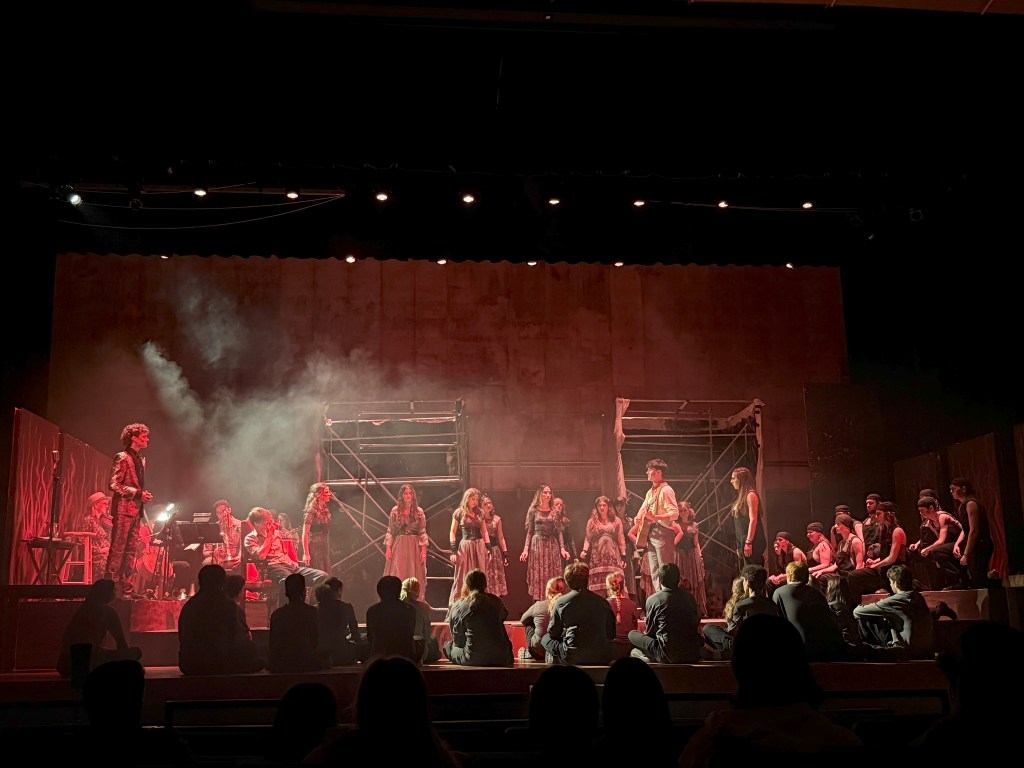
This cast and crew of just over 60 kids performed 5 runs of the musical “Hadestown” to audiences of several hundred for each show (over 500 closing night alone). They have received local, state and regional recognition and awards. But that’s not what I’m going to write about.
I’ll let you google the summary, but in a nutshell, “Hadestown” themes pit industry against nature, doubt against faith, and fear against love (Broadway.com). The lyrics echo with themes of climate change, rampant capitalism, and some scary dictatorial vibes thrown in. How do teenagers (grades 7-12) pull off these mature and complicated themes and messages? With power. And with grace. Because someone believes in them.
In the first act, Hades sings “Who do we call the enemy, my children?”
The workers answer, “The enemy is poverty and the wall keeps out the enemy and we build the wall to keep us free…” with a haunting chorus, in striking unison. The workers in Hadestown are no longer individuals, they have no names, their vacant eyes are those that have forgotten everything except for the work in front of them. Work that is “never done” and work that they’re promised “keeps them free.”
Orpheus cries out as he’s among those nameless workers:
“I believe in us together, more than anyone alone… I believe that with each other we are stronger than we know… I believe that we are many. I believe that they are few. And it isn’t for the FEW to tell the MANY what is true…”
And I can’t help but think that we are in a very strange and scary time when the FEW are doing just that. I see booksdisappearing from libraries and humans disappearing from streets. I see discrimination being rationalized and hate being encouraged, and stories being silenced, but only for certain humans. Why do certain humans get to matter while others don’t?
What happens when books and people disappear? What happens to the stories? Our beautiful, colorful, vibrant, diverse, strong, inspiring stories…?
Stories have the power to shape us and show us who we want to be, who we can be. Stories are how we share our humanity and keep our humanity. It’s the stories that make us (all humans) great. Not some of the stories, not just the ones we like, not just the ones that make us comfortable. But especially the ones that make us uncomfortable, the ones that make us think, the ones that show us different perspectives. In its purest form, a story’s power is to develop and nurture empathy.
Nothing is more powerful than a story that someone is afraid for you to hear.
When the FEW try to tell the MANY that only certain stories matter, then it is time for the MANY to show them otherwise. Just as Orpheus walks the Road to Hell with only a song, a dream and love, demanding systemic change, it is time for us to keep telling stories and keep sharing stories. Especially when the FEW try to force the MANY to be compliant and to fear taking up space.
I get so caught up in the story being told on the stage that I almost forget that these are high school kids pulling all these Big Feelings out of me- and those feelings are leaking out of my eyes. I’m inspired, infuriated, filled with passionate energy. I want to scream at the idiots in charge, who are truly the worst kinds of humans.
I want to hug all the parents of the cast and crew for raising up such beautiful teenagers. I want to hug all the teenagers, for being brave and vulnerable in their storytelling on that stage, capable of making an audience of grown-ass adults weep openly.
Adults are supposed to be in control, of our emotions, of situations. Sometimes I think that the guise of being in control is nothing more than our feelings buried under a mountain of routines and to-do lists. I am decidedly feeling a little out of control of my Big Feelings. It’s startling and unexpected but in the best ways. There is a vitality in theater and performing and I like to be reminded that inspiration and passionate energy are all around me.
It takes everyone working together to tell the story, and it takes everyone believing in the story to make the audience feel something: that when we come together, we can accomplish more than any one of us alone.
Art is a fragile magic, but so is love. Storytelling is art and love manifested. There is nothing greater than our power to create and to love. It is our defense against desperation and desolation.
We often hear “be the change you wish to see in the world.” Fighting for change and fighting for your story to be heard can be exhausting, and often you may feel you’re working so hard only to end up right back where you started. When idiots are in charge it can be overwhelming and discouraging and easy to feel lost and alone.
But as Hermes (the narrator) says, “It’s a sad song, but we sing it anyway, as if it might turn out this time.”
As long as there are passionate people singing anyway, eventually it will turn out differently.
I don’t necessarily believe that a single story will change the world. But I believe that we can change the world, one story at a time. I know a few who will lead the way.
“To the world we dream about, and the one we live in now.”
 Gretchen L. Mulroy